
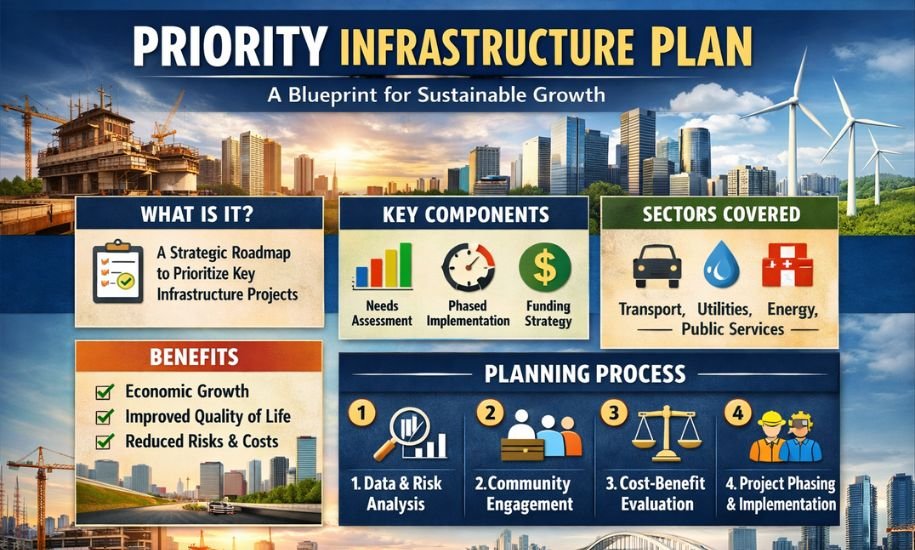
Infrastructure is the backbone of modern societies. Roads, power systems, water supply networks, digital connectivity, healthcare facilities, and public transport all play a critical role in economic stability and quality of life. However, with limited budgets, growing populations, and increasing urbanization, governments and planning authorities face the challenge of deciding which infrastructure projects deserve immediate attention and which can wait. This is where a priority infrastructure plan becomes essential.
A priority infrastructure plan is not merely a list of projects. It is a long-term strategic framework that identifies, ranks, and sequences infrastructure investments based on urgency, demand, economic impact, and sustainability. By prioritizing critical infrastructure, policymakers can ensure efficient use of resources while supporting long-term growth and resilience.
Understanding the Concept of a Priority Infrastructure Plan
A priority infrastructure plan (PIP) is a structured planning tool used by governments, municipalities, and development authorities to systematically assess infrastructure needs and determine delivery timelines. The main objective is to ensure that infrastructure development aligns with population growth, economic goals, and community needs.
Rather than responding reactively to infrastructure failures, a priority infrastructure plan promotes a proactive approach. It anticipates future demand, identifies potential capacity gaps, and sets clear priorities to guide investment decisions.
This approach helps decision-makers answer important questions:
- Which infrastructure assets are most critical right now?
- What projects will deliver the greatest social and economic benefits?
- How should limited public funds be allocated over time?
Why Priority Infrastructure Planning Is Necessary
Modern infrastructure systems are under constant pressure due to urban expansion, climate change, and technological transformation. Without a clear plan, infrastructure delivery often becomes fragmented, inefficient, and costly.
A priority infrastructure plan helps address these challenges by:
- Reducing unplanned expenditures caused by emergency repairs
- Improving service reliability for essential utilities
- Supporting economic development through timely infrastructure provision
- Enhancing transparency in public investment decisions
By clearly defining priorities, governments can avoid duplication, reduce delays, and ensure that infrastructure investments deliver maximum value.
Core Objectives of a Priority Infrastructure Plan
Every priority infrastructure plan is guided by a set of core objectives that shape its structure and implementation:
1. Efficient Resource Allocation
Public funds are finite. A priority infrastructure plan ensures that money is spent where it is most needed and where it will produce the highest return in social and economic terms.
2. Long-Term Strategic Alignment
Infrastructure investments are aligned with long-term development strategies, land-use planning, and population forecasts.
3. Service Quality and Reliability
By defining standards of service, a priority infrastructure plan ensures that infrastructure systems meet current and future demand.
4. Risk Reduction
Early identification of infrastructure bottlenecks helps reduce risks related to system failures, congestion, and environmental impacts.
Key Components of a Priority Infrastructure Plan
A comprehensive priority infrastructure plan typically includes several interrelated components that work together to guide decision-making.
Infrastructure Needs Assessment
This involves evaluating existing infrastructure assets, identifying capacity limitations, and forecasting future demand based on demographic and economic trends.
Project Prioritization Framework
Projects are ranked using criteria such as urgency, cost-benefit analysis, community impact, and environmental considerations.
Delivery Sequencing
The plan establishes a timeline for infrastructure delivery, distinguishing between short-term, medium-term, and long-term projects.
Funding and Financing Strategy
Potential funding sources are identified, including government budgets, public-private partnerships, and development contributions.
Monitoring and Review Mechanisms
Regular reviews ensure that the plan remains relevant and adaptable to changing circumstances.
Sectors Covered Under a Priority Infrastructure Plan
A priority infrastructure plan generally spans multiple sectors to ensure integrated development:
- Transportation: Roads, bridges, railways, public transit systems
- Utilities: Water supply, wastewater treatment, drainage networks
- Energy: Power generation, transmission, renewable energy infrastructure
- Digital Infrastructure: Broadband networks, data centers, smart city systems
- Social Infrastructure: Schools, hospitals, emergency services
- Community Facilities: Parks, recreational spaces, cultural facilities
Covering multiple sectors ensures that infrastructure systems support each other rather than developing in isolation.
How a Priority Infrastructure Plan Is Developed
The development of a priority infrastructure plan follows a structured and data-driven process.
Data Collection and Analysis
Planners gather data on existing infrastructure performance, population growth, land use patterns, and economic trends.
Stakeholder Engagement
Community members, industry experts, and government agencies are consulted to ensure that priorities reflect real needs.
Evaluation and Ranking
Each proposed project is assessed using a consistent evaluation framework to determine its relative importance.
Drafting and Approval
The plan is documented, reviewed, and formally adopted by the relevant authority.
Implementation and Review
Once implemented, progress is monitored, and updates are made periodically to reflect new information or policy changes.
Benefits of Implementing a Priority Infrastructure Plan
Improved Economic Outcomes
Well-planned infrastructure attracts investment, supports job creation, and enhances productivity.
Better Quality of Life
Reliable transport, utilities, and public services improve daily living conditions for residents.
Environmental Sustainability
Planned infrastructure reduces waste, promotes efficient resource use, and supports climate-resilient development.
Increased Transparency and Accountability
Clear priorities make public spending more transparent and easier to justify to stakeholders.
Priority Infrastructure Plan vs Traditional Infrastructure Planning
Traditional infrastructure planning often focuses on individual projects without considering broader system interactions. In contrast, a priority infrastructure plan adopts a holistic and integrated approach.
AspectTraditional PlanningPriority Infrastructure PlanFocusShort-term needsLong-term strategyApproachReactiveProactiveScopeIsolated projectsIntegrated systemsDecision BasisPolitical or urgent needsData-driven priorities
This strategic difference makes priority infrastructure planning more effective in addressing future challenges.
Challenges in Priority Infrastructure Planning
Despite its advantages, developing and implementing a priority infrastructure plan is not without challenges.
- Data limitations can affect demand forecasting accuracy
- Funding constraints may delay high-priority projects
- Political influences can alter priority rankings
- Changing economic conditions may require frequent plan updates
Addressing these challenges requires strong governance, transparency, and regular plan reviews.
The Role of Technology in Priority Infrastructure Planning
Digital tools and data analytics play an increasingly important role in modern priority infrastructure plans. Geographic information systems (GIS), predictive modeling, and performance dashboards help planners visualize infrastructure needs and evaluate different investment scenarios.
Smart infrastructure planning also enables better asset management and improves decision-making accuracy.
Future Trends in Priority Infrastructure Planning
As cities grow and technology evolves, priority infrastructure plans are becoming more adaptive and sustainability-focused. Future plans are likely to emphasize:
- Climate-resilient infrastructure
- Smart city technologies
- Integrated transport and land-use planning
- Community-centric development approaches
These trends highlight the growing importance of forward-thinking infrastructure strategies.
Final Thoughts
A priority infrastructure plan is more than a planning document—it is a strategic commitment to sustainable development. By identifying what matters most and planning infrastructure delivery accordingly, governments can ensure economic stability, social well-being, and environmental resilience.
For readers seeking in-depth insights into governance, planning, and development strategies, platforms like angliatimes play an important role in sharing knowledge and fostering informed discussions around infrastructure and public policy. As infrastructure challenges continue to grow, well-researched perspectives published on sites such as angliatimes help bridge the gap between policy decisions and public understanding.
